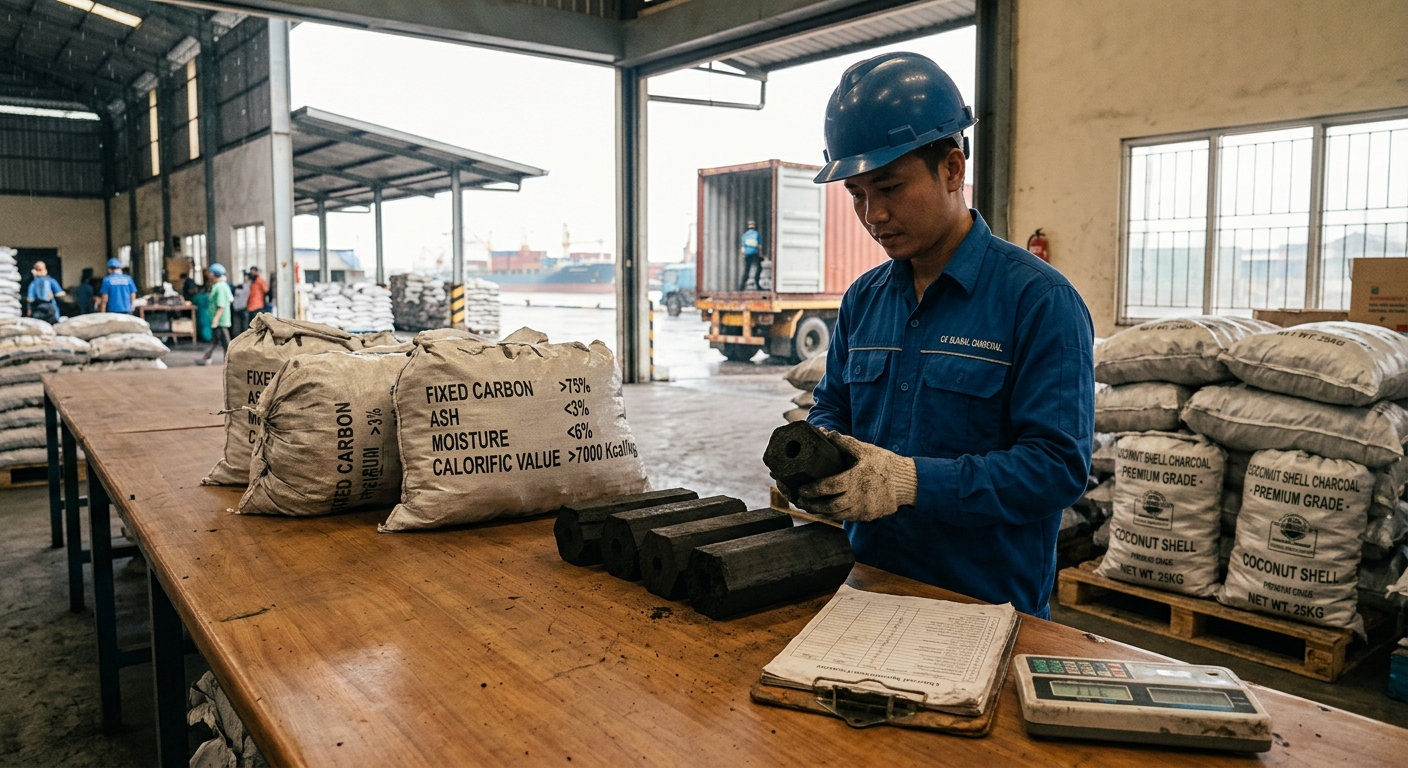
Introduction to Coconut Charcoal Export
The global demand for sustainable and high-quality fuel sources has driven the exponential growth of the coconut charcoal market. Coconut shell charcoal, particularly formed into briquettes, is highly prized for its long burning time, minimal ash production, and eco-friendly nature. Whether used for shisha (hookah) or barbecue (BBQ), international buyers demand strict adherence to specific quality standards. Understanding the precise coconut charcoal specifications for export is crucial for suppliers aiming to penetrate and succeed in the international market.
Key Quality Metrics for Export-Grade Coconut Charcoal
Exporting coconut charcoal requires strict quality control. International buyers typically request a Certificate of Analysis (COA) from an independent laboratory before confirming orders. The primary specifications evaluated include moisture content, ash content, volatile matter, and fixed carbon.
Fixed Carbon
Fixed carbon is the most critical metric for assessing the quality of coconut charcoal. It dictates the burning time and heat output. For premium export quality, specifically for shisha briquettes, the fixed carbon content should typically exceed 75%. A higher fixed carbon percentage means a longer, hotter burn with less smoke.
Ash Content and Color
Ash content affects both the burning experience and the cleanup process. Premium shisha charcoal demands an ash content of less than 2.5%, while BBQ charcoal can tolerate slightly higher levels, usually up to 5%. Furthermore, the color of the ash is heavily scrutinized; buyers generally prefer pure white or light grey ash, which indicates a complete burn and the absence of impurities or chemical additives.
Moisture Content
Moisture content directly impacts the ignition time and weight of the charcoal. Export standards dictate a maximum moisture content of 5% to 8%. Excessive moisture makes the charcoal difficult to light, produces unwanted smoke, and can cause the briquettes to crack or shatter when heated.
Volatile Matter
Volatile matter refers to the components of coal, except for moisture, which are driven off as a gas at high temperatures. High volatile matter leads to excessive smoke and a faster burning rate. For export-grade coconut charcoal, volatile matter should ideally be kept between 10% and 15%.
Comparing Shisha and BBQ Charcoal Specifications
The specifications for coconut charcoal vary depending on its intended end-use. Below is a comparison of the typical requirements for shisha (hookah) briquettes versus barbecue (BBQ) briquettes.
| Specification Metric | Shisha (Hookah) Charcoal | Barbecue (BBQ) Charcoal |
|---|---|---|
| Fixed Carbon | 75% - 85% | 65% - 75% |
| Ash Content | Max 2.5% | Max 5.0% |
| Volatile Matter | 10% - 15% | 15% - 20% |
| Burning Time | 90 - 120 minutes | 120 - 180 minutes |
Physical Specifications: Shapes and Sizes
Beyond chemical composition, the physical dimensions and shapes of coconut charcoal briquettes are strictly specified by importers based on consumer preferences.
Shisha Briquette Shapes
- Cube: The most popular shape globally. Standard sizes include 22x22x22 mm, 25x25x25 mm, and 26x26x26 mm.
- Flat / Cuboid: Often measuring 25x25x15 mm, favored in certain Middle Eastern markets.
- Hexagonal / Finger: Typically produced with a center hole to promote airflow, generally measuring 20x50 mm.
BBQ Briquette Shapes
Barbecue briquettes are usually larger to sustain long grilling sessions. Common shapes include hexagonal logs (often measuring 50x100 mm or larger) and pillow shapes. The focus here is on maximizing the surface area and density to ensure a steady, high-heat output over several hours.
Packaging and Shipping Standards
Meeting product specifications is only half the battle; export packaging must also meet stringent international standards. Charcoal is considered a potentially hazardous material (spontaneously combustible) under maritime shipping regulations, although correctly processed coconut shell charcoal briquettes can often be classified as non-hazardous if they pass the Self-Heating Test (UN N.4).
Standard packaging for shisha charcoal usually involves an inner plastic lining to prevent moisture ingress, packed inside full-color printed inner boxes (usually 1kg), which are then placed into a master corrugated carton (typically 10kg or 20kg). Palletization must be robust, using heat-treated wooden pallets to comply with ISPM 15 standards.
Conclusion
Successfully exporting coconut charcoal requires a deep understanding of international specifications and unwavering commitment to quality control. By strictly monitoring fixed carbon, ash content, volatile matter, and moisture, and by adhering to the physical and packaging requirements of target markets, manufacturers can build a strong reputation and secure long-term international buyers. As the global shift toward sustainable energy continues, the market for premium coconut charcoal will only expand, offering lucrative opportunities for suppliers who meet these rigorous standards.
Frequently Asked Questions (FAQ)
What is the most important specification for export coconut charcoal?
Fixed carbon is widely considered the most important specification. It determines the heat value and burning time of the charcoal. Premium export grades typically require a fixed carbon content of over 75%.
Why is ash color important in shisha charcoal?
Ash color is a strong indicator of the charcoal's purity and the raw materials used. A white or light grey ash implies clean coconut shell feedstock without chemical additives or wood contamination, which is highly preferred by shisha consumers.
How does moisture content affect shipping?
High moisture content can degrade the structural integrity of the briquettes during transit, leading to cracking and excessive dust. It also increases the overall weight of the shipment, increasing freight costs without adding value to the end product.
Do I need a special certificate to export coconut charcoal?
Yes, exporters generally need a Certificate of Analysis (COA) from a recognized laboratory. Additionally, a Material Safety Data Sheet (MSDS) and a Self-Heating Test certificate (UN N.4) are often required by shipping lines to prove the cargo is not prone to spontaneous combustion.
Comments
Post a Comment