For hookah enthusiasts and lounge owners alike, achieving the perfect smoking session is a delicate art. One of the most common challenges faced during this process is managing the ash produced by hookah charcoal. Excessive ash can negatively impact the flavor of the shisha, disrupt heat management, and create an unnecessary mess. Understanding how to reduce ash in hookah charcoal is essential for a clean, flavorful, and long-lasting session. In this comprehensive guide, we will explore the science of hookah charcoal, the factors that contribute to ash production, and actionable strategies to minimize it.
Understanding Hookah Charcoal and Ash Production
Before diving into reduction techniques, it is crucial to understand what causes charcoal to ash. Ash is the inorganic residue left behind after the combustion of organic matter. In the context of hookah charcoal, this residue consists primarily of minerals such as calcium, potassium, and magnesium that were present in the source material (like coconut shells or wood) and did not burn away.
There are two primary types of hookah charcoal available on the market, each with different ashing characteristics:
- Natural Coconut Charcoal: Made from compressed coconut shells, this type is the gold standard for hookah smokers. It burns hotter, lasts longer, and generally produces significantly less ash compared to other alternatives.
- Quick-Light Charcoal: These coals are coated with a chemical accelerant (often sulfur or saltpeter) to allow them to be lit easily with a standard lighter. While convenient, they burn much faster, alter the flavor of the shisha, and produce a high volume of fine, powdery ash.
Why Excessive Ash is a Problem
Managing ash is not just about keeping your hookah setup clean; it directly affects the quality of your smoking experience. Here is why reducing ash should be a priority:
- Flavor Degradation: If fine ash falls through the holes of your foil or heat management device (HMD) and mixes with the shisha, it can impart a harsh, bitter, or charcoal-like taste to the smoke.
- Heat Interference: A thick layer of ash acts as an insulator. It prevents the radiant heat of the glowing coal from effectively reaching the shisha, leading to weak smoke output and a lackluster session.
- Mess and Maintenance: High-ash coals require constant ashing (tapping the coals to remove the outer layer of ash). This increases the risk of dropping hot coals and creates a dusty environment around your hookah setup.
Effective Strategies to Reduce Ash in Hookah Charcoal
Reducing ash begins long before you light your coals and continues throughout your smoking session. By implementing the following strategies, you can drastically decrease ash production and improve your overall experience.
1. Invest in Premium Coconut Charcoal
The most effective way to reduce ash is to start with a high-quality product. Premium natural coconut charcoals undergo a rigorous manufacturing process that filters out impurities. When purchasing charcoal, look for brands that explicitly state their ash content; premium brands typically boast an ash content of less than 2.5%. Avoid quick-light coals entirely if you are serious about reducing ash and preserving flavor.
2. Proper Storage is Key
Charcoal is highly porous and will absorb moisture from the surrounding environment. When coals absorb humidity, they burn unevenly, produce less heat, and generate significantly more ash. To prevent this, always store your hookah charcoal in a cool, dry place. Keep them in an airtight container or a heavy-duty plastic bag with a secure seal. Do not leave the original cardboard box open in a humid room or outdoors.
3. Perfect Your Lighting Technique
How you light your coals can impact how they burn and ash during the session. Coals must be lit completely before they are placed on the hookah bowl. Use an electric coil burner and allow the coals to heat until they are glowing red-hot on all sides, with a thin, uniform layer of grey ash covering the exterior. If you place partially unlit coals on your bowl, the uneven combustion will lead to irregular ashing and a drop in temperature.
4. Utilize a Heat Management Device (HMD)
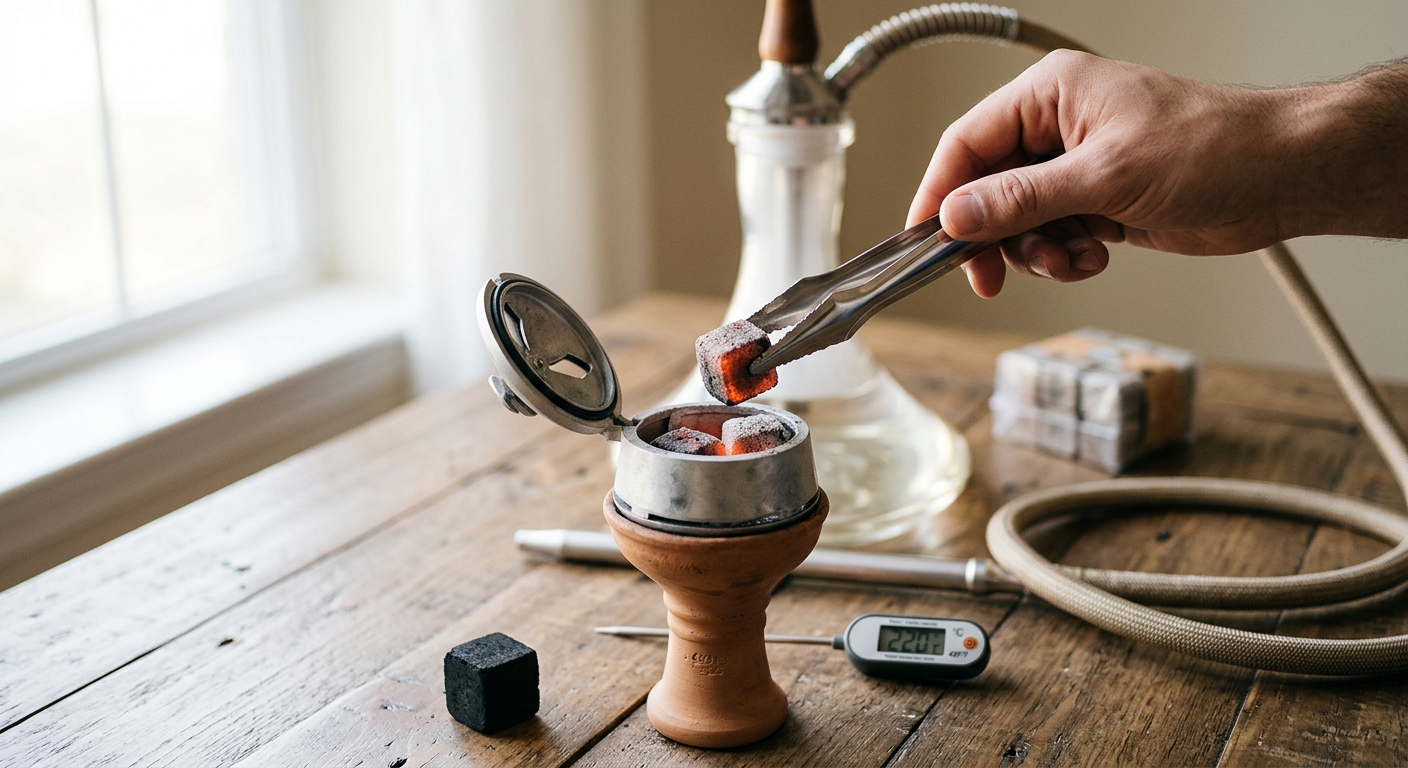
While an HMD does not stop the charcoal from producing ash, it is highly effective at containing it. Devices like the Kaloud Lotus or Apple On Top Provost sit over the shisha and house the glowing coals. These devices have specialized vents and solid bottoms (with strategic slits) that prevent ash from falling into the shisha tobacco. This ensures that even if your coals do ash, the integrity of your flavor remains uncompromised.
5. Practice Proper Heat Management and Ashing
During your session, you will inevitably need to manage the coals. Instead of letting ash build up until it suffocates the coal, proactively ash your coals every 15 to 20 minutes. Pick up the coal with your tongs and gently drop it directly into your ash tray from a low height (about one inch). This knocks off the insulating layer of ash, revealing the glowing red core, which restores the heat output and prevents excess ash from accumulating on top of your bowl.
Comparison of Charcoal Types and Ash Output
To better illustrate the differences in ash production, refer to the table below comparing the most common hookah charcoal types:
| Charcoal Type | Source Material | Average Ash Content | Impact on Flavor | Burn Time |
|---|---|---|---|---|
| Premium Coconut | Coconut Shells | Under 2.5% | Minimal to None | 60 - 90 Minutes |
| Standard Natural | Mixed Woods/Shells | 3% - 5% | Slight Woody Taste | 45 - 60 Minutes |
| Quick-Light | Wood dust + Chemicals | Over 10% | Harsh, Chemical | 30 - 45 Minutes |
Conclusion
Reducing ash in hookah charcoal is a vital step toward mastering the art of the perfect hookah session. By prioritizing high-quality natural coconut coals, storing them correctly to avoid moisture absorption, and ensuring they are fully lit before use, you can drastically cut down on unwanted ash. Furthermore, integrating a Heat Management Device and practicing regular, gentle ashing will protect your shisha from contamination and maintain optimal heat levels. Implementing these professional techniques will guarantee a cleaner, more flavorful, and highly satisfying smoking experience every time you set up your hookah.
Frequently Asked Questions (FAQ)
Why does my charcoal turn completely to ash so quickly?
If your charcoal is reducing to ash rapidly, it is likely due to either low-quality charcoal (such as quick-lights) or excessive airflow. Quick-light coals burn much faster than natural coconut coals. Additionally, smoking outdoors in a breezy environment or using a fan nearby supplies excessive oxygen to the coals, causing them to combust and turn to ash much faster than they would in a controlled indoor setting.
Can I reuse partially burned hookah charcoal?
It is generally not recommended to reuse partially burned hookah charcoal. Once a coal has been lit and extinguished, its structural integrity is compromised. Re-lighting it will often result in a highly fragile coal that produces an excessive amount of ash, burns unevenly, and fails to reach the optimal temperature needed for a good smoking session.
Does blowing on the coals help reduce ash?
Blowing on the coals does not reduce the total amount of ash produced; in fact, it accelerates combustion, which can generate ash faster. While blowing on coals can temporarily blow away loose ash and stoke the heat, it often creates a mess by scattering fine ash particles into the air and onto your shisha. It is much better to gently tap the coals in an ashtray to remove the outer layer of ash.
What is a Heat Management Device (HMD) and how does it help with ash?
A Heat Management Device is a metal accessory that replaces traditional aluminum foil on a hookah bowl. You place your lit coals inside the HMD, and it regulates the transfer of heat to the shisha tobacco. HMDs are incredibly helpful with ash management because their solid bases catch the ash, preventing it from falling directly onto the shisha, thereby preserving the purity and flavor of your smoke.
Comments
Post a Comment